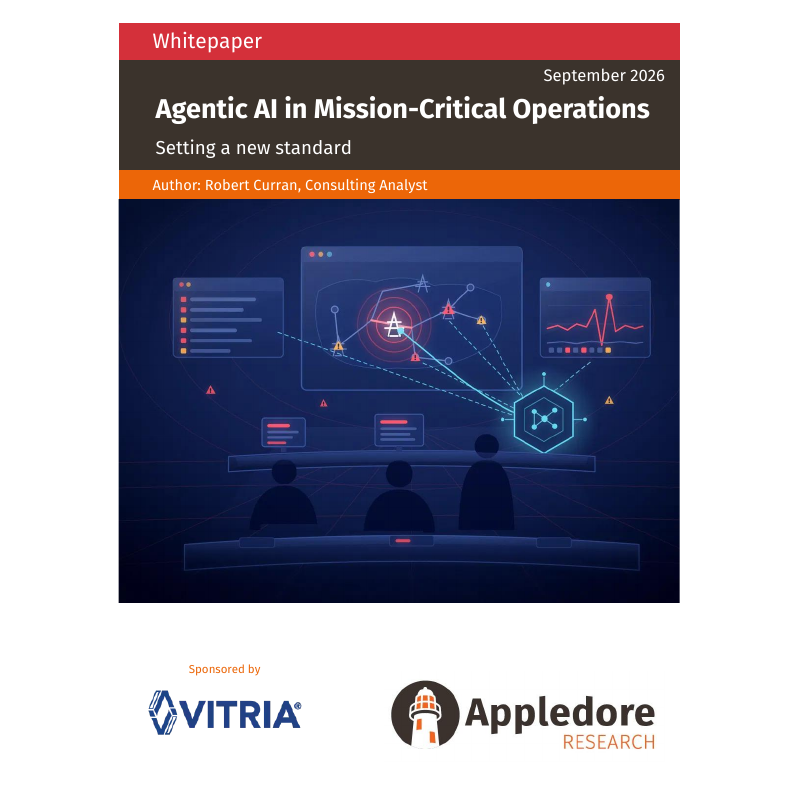
Agentic AI in Mission-Critical Operations: Setting a new standard
When the cost of an incident compounds by the minute, spotting it isn’t the job. A new Appledore Research paper sets out what an operations system has to do instead, turns it into thresholds you can test, and ends with six questions to put to any vendor claiming to meet them.
Abstract
Mission-critical operations are not a harder version of IT operations. They are a separate category, defined by failures whose cost compounds non-linearly until it becomes irreversible. In this whitepaper, we set out what agentic AI must deliver to operate safely in that context: real-time detection and rapid resolution, multi-domain scale, cross-domain correlation, behavioral semantics, and the ability to validate a fix before it is applied. The paper quantifies each requirement into thresholds a buyer can test, contrasts them with what general-purpose AIOps and traditional service assurance deliver today, and identifies the knowledge plane as the least developed and hardest to acquire of the three capabilities required. It closes with six questions that separate a genuinely capable system from a re-badged monitoring platform. Drawn from large-scale telecom network operations, the standard is industry-neutral.
What the paper covers
- Why compounding impact makes mission-critical operations a distinct category rather than a demanding one
- Five requirements that follow from real-time resolution, each quantified into a testable threshold
- The difference between behavioral and definitional semantics, and why only the first supports safe action
- The knowledge plane as the third plane alongside observability and control
- How to introduce a new system into an estate that cannot be switched off, and earn the right to retire the incumbent
- Six questions that separate a capable system from a re-badged monitoring platform
Why now
Agentic AI is arriving in operations faster than the governance around it, and the paper names the failure mode: the Agentic Fallacy, or the assumption that faster automated action is the point. Where impact compounds, a wrong action spreads exactly as fast as a right one resolves. What separates them isn’t the model. It’s whether the system knows how the estate behaves and can check before it acts.
This paper is free to read (no registration required) courtesy of sponsorship by Vitria Technology.
This report is available as part of an Appledore subscription.