Charter/Cox Merger
“The merger is cable’s scale response to access market disruption — not a competitive move against Comcast.”
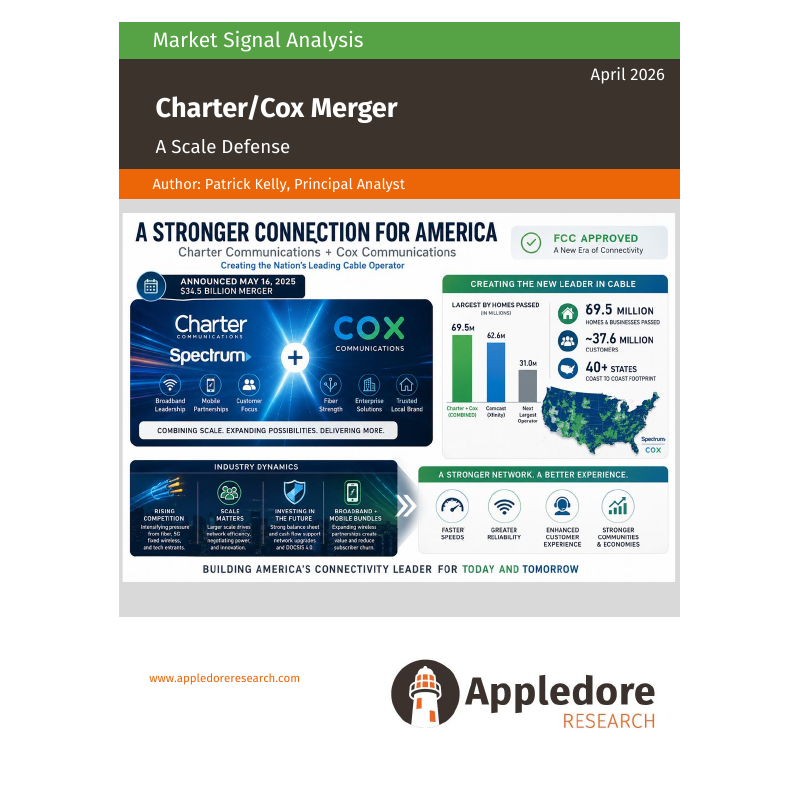
Charter Communications’ $34.5 billion acquisition of Cox Communications is the most significant cable consolidation transaction in the United States since 2016, creating a combined operator with 69.5 million homes and businesses passed, approximately 35.6 million broadband subscribers, and roughly 37.6 million total customer relationships. This note argues that the merger is fundamentally misunderstood when framed as a cable-versus-cable competitive move. Charter and Cox serve overwhelmingly distinct geographic footprints. The merger is cable’s structural response to platform substitution — the systematic erosion of cable’s legacy broadband position by AT&T fiber, T-Mobile fixed wireless access, Verizon FiOS, and regional fiber overbuilders.
Charter’s Q1 2026 earnings, which reported a loss of 120,000 broadband subscribers and triggered the worst single-day share price decline in the company’s history, validate this thesis in real time. The competitive battlefield has permanently shifted: cable broadband plus mobile bundle versus telco fiber plus wireless bundle versus fixed wireless access price disruptors.
Beneath the headline mobile growth story — Charter’s 11.77 million Spectrum Mobile lines at 22% revenue growth — lies a more consequential strategic development. Charter is actively building wireless infrastructure independence through CBRS spectrum deployment and strand-mounted small cells, in partnership with Nokia. Approximately 88% of Charter’s mobile traffic now runs on infrastructure it controls. The target is 30% CBRS traffic offload, translating into approximately $530 million in annual Verizon wholesale cost savings. The Cox acquisition extends this programme across an additional 5.9 million broadband subscribers with minimal existing wireless infrastructure — representing years of incremental offload opportunity.
Assessed through the Appledore Autonomous Operations Blueprint, the merger’s greatest integration risk sits at Layer 1: establishing a unified semantic knowledge foundation across two independently operated networks is the prerequisite for reliable automated traffic steering, AIOps, and closed-loop service assurance at scale. The combined entity’s financial position supports automation investment, but integration costs and leverage require careful sequencing. The $530 million wholesale savings target is only achievable if the operational data foundation is built first.
Key questions answered in this report:
- Does the combined entity’s financial position support accelerated automation investment, or will integration costs constrain it?
- What does a 35M+ combined broadband subscriber base mean for the scale of automation and AI opportunity?
- Which layer of the Appledore Autonomous Operations Blueprint presents the greatest integration challenge — and opportunity?
- How does the combined entity’s scale change the supplier dynamic? Who gains leverage and who loses it?
- What does this mean for the other US cable operators — specifically Comcast and Optimum?